where \(\beta(\epsilon)\) is the electron kinetic energy (\(\epsilon\)) dependent anisotropy parameter, which varies between −1 and +2, and \(P_2(\cos\theta)\) is the 2nd-order Legendre polynomial in \(\cos\theta\). \(\sigma_\text{total}\) is the total photodetachment cross section. The anisotropy parameter provides phase information about the dynamics of the photon process [1].
PyAbel provides several methods to determine the anisotropy parameter \(\beta\):
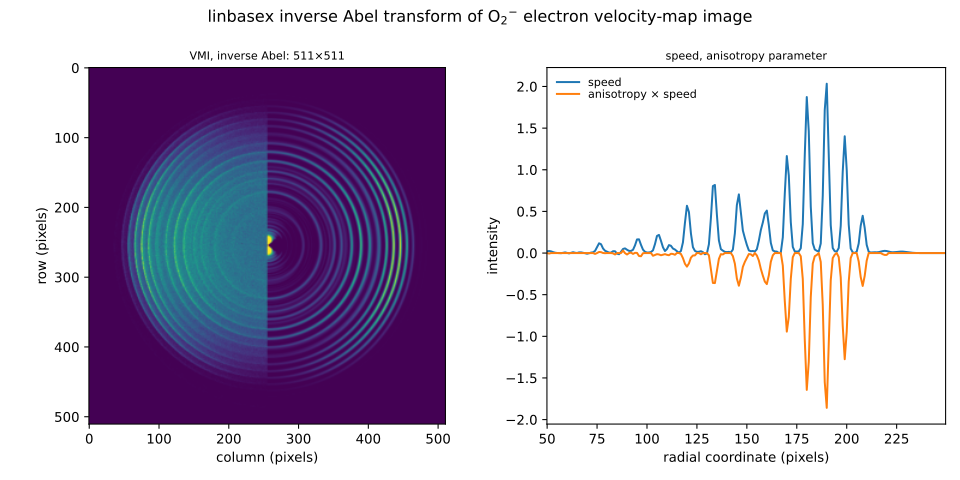
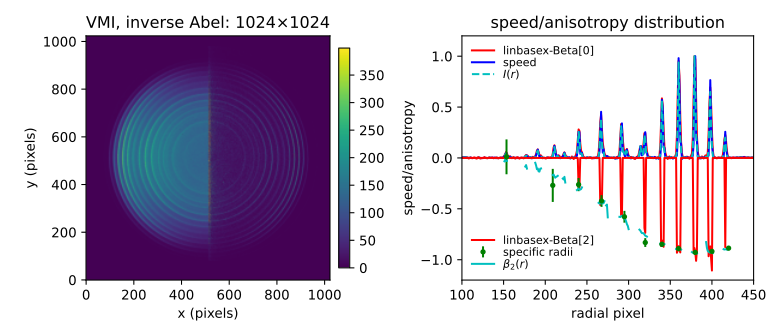
Method 1: linbasex evaluates \(\beta\) directly, available as the class attribute Beta[1].
This method fits spherical harmonic functions to the velocity-map image to directly determine the anisotropy parameter as a function of the radial coordinate. This parameter has greater uncertainty in radial regions of low intensity, and so it is commonly plotted as the product \(I \times \beta\). See Example: Linbasex.
This method determines the anisotropy parameter from the inverse Abel-transformed image, by extracting intensity vs angle for each specified radial range and then fitting the intensity formula given above. This method is best applied to the radial ranges corresponding to strong spectral intensity in the image. It has the advantage of providing the least-squares fit error estimate for the parameter(s).
This method, like the previous one, works on the inverse Abel-transformed image, but fits the angular intensity dependence at each radius, providing radially dependent anisotropy parameters, like in the first method. If the anisotropy parameters are known to be smooth radial functions, a moving-window averaging can be employed for noise reduction.